

"It has to be like taking the bus"
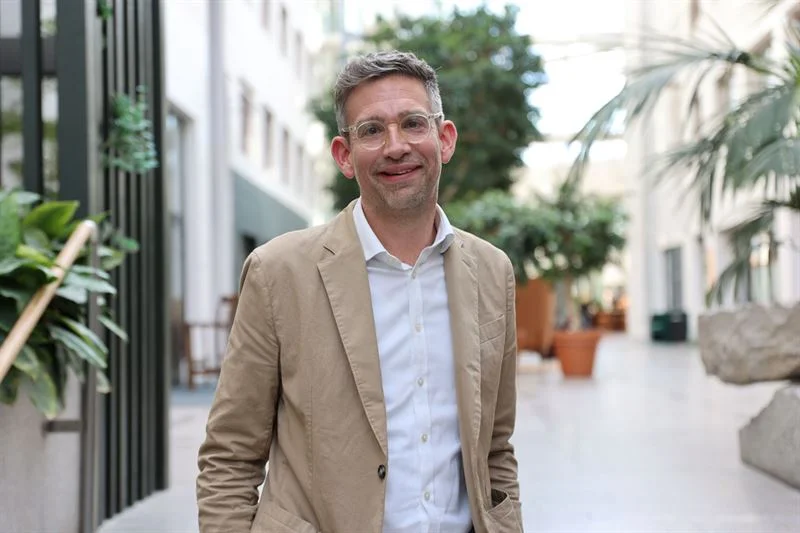
Ed Fotheringham, VP Global Sales at SAS, on what the Nordics buy, the say-do gap on sustainability, and why AI books nothing yet. First conversation in Nordic Perspectives, the NBTS27 interview series.
Before Ed Fotheringham took the job at SAS, he spent six months travelling the world as a passenger. Twenty years of selling travel, at British Airways, Premier Inn, Cathay Pacific and Etihad, in London, Seoul, Hong Kong and Abu Dhabi, and then half a year on the other side of the counter, mostly in Southeast Asia, on whatever airline flew the route.
"You start to understand the fragmented nature of travel," he says. "Many airlines have the same seats, many airlines go the same routes. But how do you mitigate disruption to a customer in a world where there is more disruption?"
The answer he came back with was not about product. "When somebody cared in the moments that mattered to me, that was the difference between a normal bit of hospitality and an amazing experience. How you build the capability to deliver for a customer in those moments: that was the biggest learning."
What is Nordic about the Nordic buyer
Fotheringham moved to Stockholm two years ago, after Abu Dhabi, Hong Kong, Seoul, Johannesburg and London. The thing that struck him first about the Nordic market was not culture but geography.
"You have a relatively sparse population and an incredibly large geography. It's the first airline I've worked for with such a big domestic footprint. If you're travelling from Oslo to Tromsø, the rail journey or the car journey is prohibitive. So, Nordic travel buyers look at the value of a domestic network more the way a North American buyer would than a European one. In Europe it's about interconnectivity. Here it's about getting your people around your own country first."
Add a digital-first culture with a high take-up of online booking tools, and a set of export industries that need the rest of the world, from Swedish unicorns to Norwegian oil and gas and Danish pharmaceuticals, and you have a buyer with a specific shape. "Connectivity equals growth. You're getting customers in and taking your products out."
Some of SAS's most frequent flyers commute by plane. "They take an SK flight between Bergen and Stavanger the way I take the bus in Stockholm. If you're doing it every day, it has to be like public transport. It has to be like a bus. It cannot have friction points. Otherwise the journey becomes the thing that matters, and the thing that matters is the meeting you're going to."
Friction, for him, is an industry problem rather than an airline one. A friend of his recently spent an hour and ten minutes in a passport queue entering Marseille. "The more friction you have, the less enjoyable it becomes, and the less likely you are to do it again."
What has changed since 2019
Asked what travel managers ask for now that they didn't before the pandemic, Fotheringham lists four things, and then adds a fifth he thinks matters more.
Travel has become more intentional. "Are you travelling for a customer growth meeting? For an effective project delivery meeting? It no longer just happens." Sustainability has become standard, with a Nordic twist: "Train travel is going through the roof between Stockholm and Gothenburg. You can't do that between Luleå and Stockholm. So how do you make sustainability standard in the geography we live in?" Traveller wellbeing has moved up the list, along with reliability and support when things go wrong. And technology: online booking tools, policy compliance, better insight for the travel manager.
The fifth is the one he keeps returning to. "The classic procurement travel manager is challenged by the CFO: your job is to get a better price. The way you do that is either travel less or fight for lower prices. But with dynamic pricing you no longer have static fares you can apply a set discount to. It's going to be very hard to say 'these are the savings my programme delivered'. We as an industry need to start working with buyers to report the value it gives the organisation. That's the next big shift."
The say-do gap
Fotheringham has a way of measuring the distance between what the industry says about sustainability and what it does. He did it in a conference hall.
"I asked: who cares about the environment? 150 people put their hand up. Who flew here today? 120. Who bought a sustainable aviation fuel ticket, or added it as an ancillary? Twelve hands went up."
He does not read that as hypocrisy. "There is very much a willingness to do something about it. There's a lot of complexity in the middle. Fourteen different methodologies, twelve different reporting capabilities. Am I going to buy my SAF in Denmark, or in southern Spain where it's two-thirds of the price?" The gap is closing, he says, fastest among large corporations that buy SAF in bulk or write a carbon price into their TMC agreement. But the industry owes buyers a single standard. "You need a single source of truth."
Advisors, not suppliers
What do travel managers get wrong about airlines? "They have an opportunity to see airlines as a trusted advisor, a consultant. They naturally see their TMC in that role, because they have one TMC and many suppliers. But airlines see industry trends. We can help educate."
And the reverse? "We often just see the travel manager as the cost gatekeeper hammering for another few percent in the discount. There's a bigger movement in travel management now: how do I explain the value of everything we do to my own organisation? If we work together on that, the whole value chain benefits."
AI: inspiration, not booking
On AI, Fotheringham is precise about where the line sits today. "AI in travel at the moment is very much about inspiration. I want to go somewhere hot, I've got two kids, this is my budget. The ability to take that from inspiration to book and pay doesn't really exist. That's the big gap."
The next step, search within a managed programme, is arriving: "Two options for your business trip to Gothenburg next week. That's here now." Full agentic distribution, where a traveller's AI agent negotiates with an airline's, is further out than the conference circuit suggests. "You don't want to build all of that on the legacy platform we have today. It's like putting a sticky plaster over a VHS recorder when you could stream."
The point of automation, in his view, is to make room for people. He gives an example from customer service: today a call is prioritised by loyalty tier; with the right data it could be prioritised by urgency, the traveller with a flight in ninety minutes ahead of the one with a flight in seven days. "We are emotional human beings. We're more likely to trust a human than AI. Will you be inspired by AI? Yes. Will you let it recommend a hotel? Yes. Will you let it pay for you? We all still say no. So how do you use technology to free up humans for the moments that matter?"
The prediction
Every Nordic Perspectives conversation ends with one belief the room in Copenhagen might not share. His: "Passports will be a thing of the past in many parts of the world by 2028." By that he means the physical document: facial recognition takes its place.
He speaks as a non-Schengen citizen who queues at Arlanda every time he comes home. "In Abu Dhabi I never took my passport out of my pocket. Not at check-in, not at immigration, not at boarding." The Nordics, he thinks, will be slower, and not for technical reasons. "It goes back to the Scandinavian trust piece: personal data, privacy. Will people take the seamlessness, or will other Nordic virtues trump that? I don't think people here believe passports won't exist in 2028."
Ed Fotheringham is VP Global Sales at SAS – Scandinavian Airlines, a Platinum Partner of NBTS27. Nordic Perspectives is the NBTS27 interview series with sponsors and industry leaders, produced by Lindhagen Studio. NBTS27 takes place at Scandic Copenhagen on 16–17 March 2027.